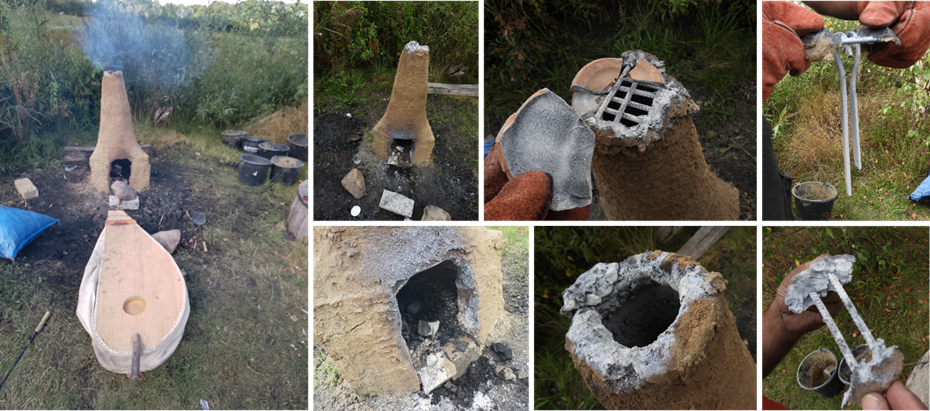
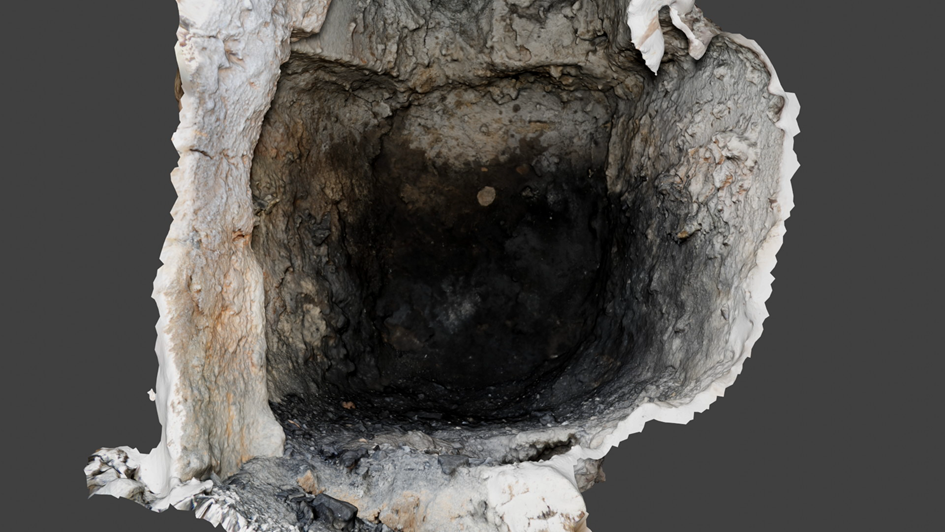
This spontaneous formation of zinc oxide in the furnace atmosphere represents the moment when kadmeia becomes materially visible, as a white concretion produced by zinc-rich furnace vapours, and likely played a key role in its ancient recognition as a distinct compound. This gas interacts with all materials it encounters, the furnace walls, made of ceramics or stones with ceramic lining, and the furnace batch where it enters the slags, remaining as fundamental evidence.
Pyritic smelting and cementation were experimentally reproduced within the project to better understand the processes underlying the formation, recognition, and use of zinc-rich compounds. Smelting trials in which roasting and reduction occur within the same furnace allowed the observation of zinc oxide formation as a spontaneous by-product of zinc-rich ore smelting, while cementation experiments focused on the diffusion of zinc into solid copper for brass production.
Together, these experimental approaches provided a practical framework for interpreting ancient textual descriptions, but also the archaeological evidence related to Kadmeia.
Pyritic smelting:
During the smelting of zinc-rich ores such as sphalerite, desulphurization takes place in the oxidising zone of the furnace, on top of the charcoal and does not require a separate process, as the reaction is exothermic and proceeds spontaneously with sufficient heat and ventilation. This step is essential because residual sulphur would inhibit the subsequent distillation of zinc; desulphurization ideally follows the reaction
ZnS + 3O → ZnO + SO₂,
although sulphatation:
ZnS + 4O → ZnSO₄
may also occur as an interfering process. After desulphurization, the ore moves into the reducing zone of the furnace, where zinc oxide is reduced at temperatures around 900–1000 °C to metallic zinc in gaseous form (ZnO + C → Zn + CO). The exothermic reactions of desulphurization, which carry on spontaneously like burning reactions, can release the additional energy required for the endothermic reduction of zinc oxide into the metallic Zn, in gaseous form at the experimental conditions. Once the zinc vapour reaches oxidising conditions, such as near the furnace walls or chimney, it re-oxidises and deposits as zinc oxide (ZnO), forming the white concretion historically recognised as kadmeia.
This oxide is not soluble and, with a bit of luck, can resist and be found during archaeological excavations or surveys.
Brass cementation:
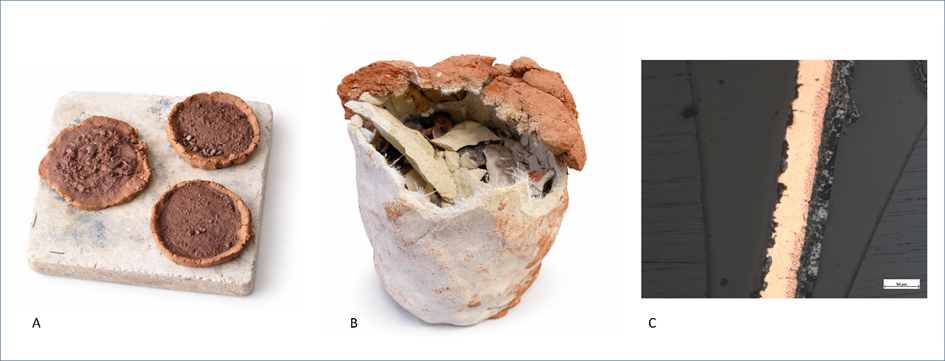
Cementation experiments were carried out to understand how a charge of zinc-rich ores or zinc oxide can supply zinc for absorption into copper sheets in a solid or semi-solid state. These experiments helped to clarify which components of the ores effectively contribute to the process and how the crucible behaves during firing. The copper sheets gradually turned yellow, indicating successful cementation, and when the crucible was opened, a beard-like deposit of zinc oxide crystals was observed along the rims. These features provide clear material indicators of the reactions taking place during the cementation process.
First experiments have been carried out with fragmented sphalerite-rich ores from Bad Grund (Oberharz, Germany), putting the ore with powdered charcoal in aclosed crucibles. The experiment was aimed to observe the absorption in ceramics, as it is visible in the picture, the crucibles assume a gray-lila color, observed experimentally in other experiments of zinc absorption.
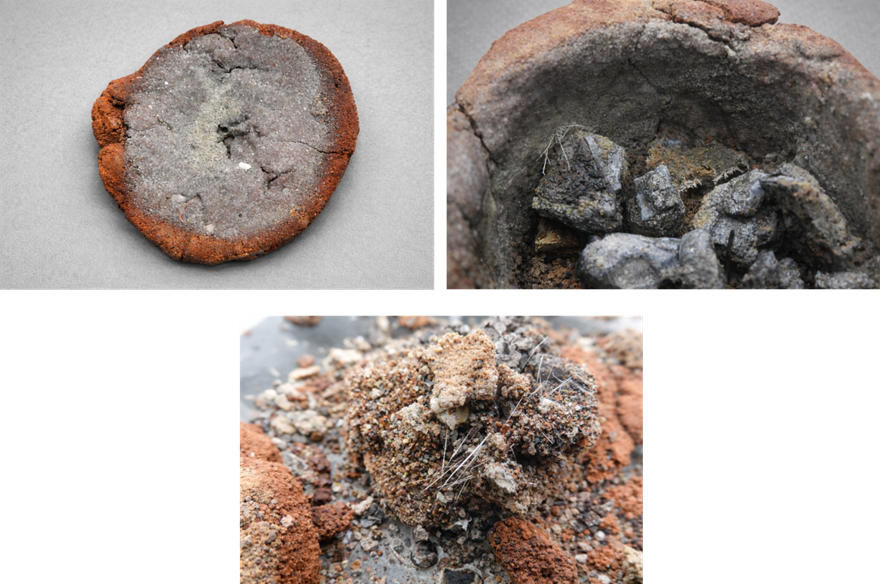
More complex experiments have been conducted in the DBM (Bochum, Germany), to understand specifically which elements are released during the reduction of Rammelsberg sphalerite-rich ores. The first trials didn’t contain copper in the crucible, which was instead sealed. AAgain the Zinc absorption is recognisable, as the ceramic is a way too complex medium or carrier, to make a clear quantification of trace elements coming certainly from the Rammelsberg ore. A bettering of the experiment made use of copper leaves (uncertified, but clean at 99.9%) in the sealed crucibles and trials have also been conducted with pre-roasted ore. The copper leaft work very well as a carrier, and it turned into ayellow brass.
Experiments as didactic moments to involve the public
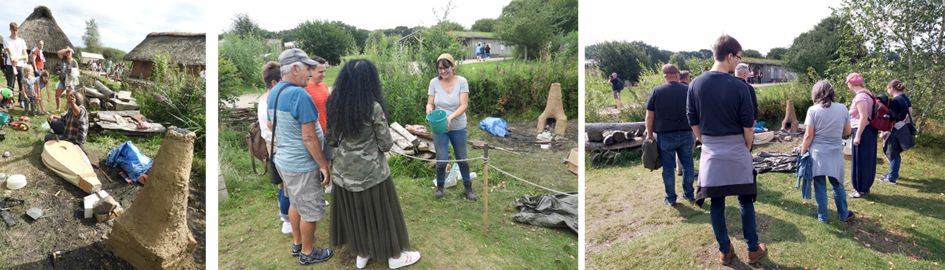
These experiments provide an essential knowledge base for the researcher when searching for archaeological evidence during field surveys and in museum storerooms. At the same time, experimental activities offer valuable opportunities for engaging with the public, making metallurgical processes tangible and easier to understand.