Conceptual framework and background for DE-CADMEA
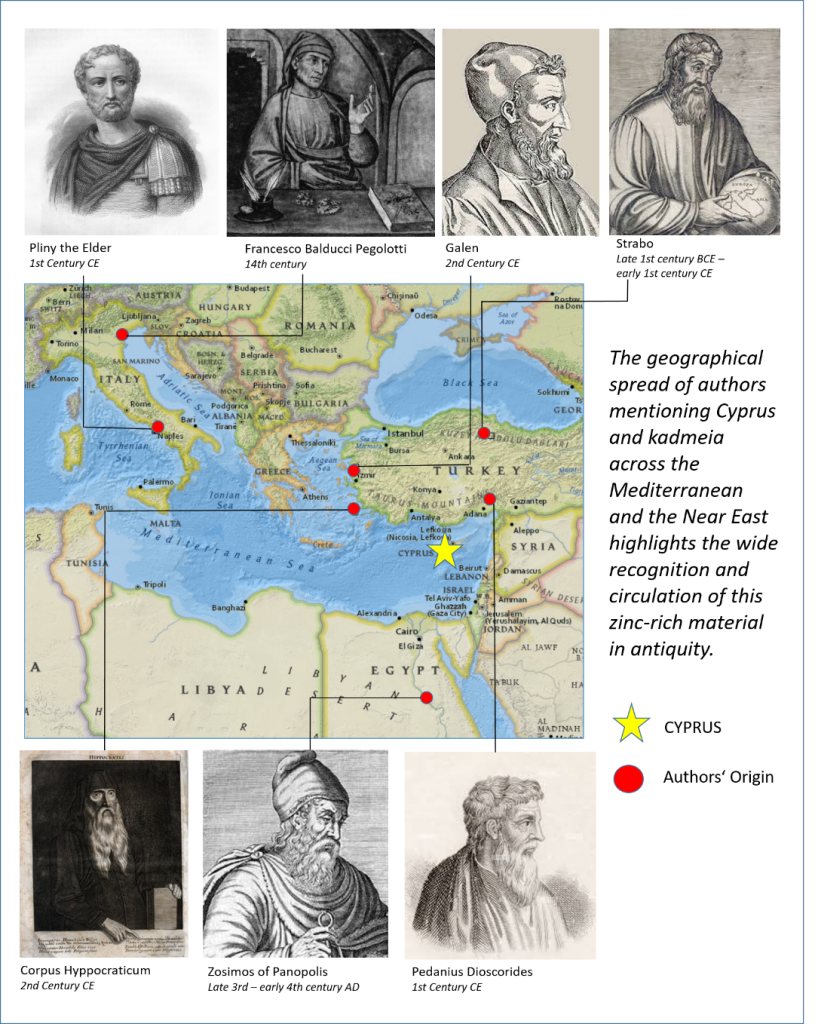
The DE-CADMEA research originates from a critical reading of ancient textual sources, which describe kadmeia within its historical and geographical contexts of recognition and use. These sources are essential for understanding how the term was applied to different materials and metallurgical practices. The following authors are particularly relevant as their writings either describe the nature of kadmeia, its use, and often identify Cyprus as the place where its highest-quality form was produced or obtained.
Hellenistic and Early Classical References
Diagoras the Cypriot (3rd century BC) and Corpus Hippocraticum
Kadmeia appears in ancient medical literature as an ingredient employed by Greek physicians. Of particular interest is a recipe attributed to Diagoras the Cypriot (3rd century BC), who used cadmes in the preparation of his so-called “great collyrium”, a medicinal eye means explicitly associated with Cyprus.
Related terminology is also found in the Corpus Hippocraticum, where zinc oxide is described as the “ashes of Laurion”, analogous to the “ashes of Cyprus” (Halleux 1973), also here referred in a medical ambit.
Early Imperial Roman Authors (1st–2nd century AD)
Strabo (early 1st century AD, citing Posidonius)
Strabo refers to zinc-bearing compounds in the island, drawing on earlier authors such as Posidonius. In Geographia (III, 4, 15), he states that Cypriot copper uniquely yields kadmeia lithos, chalcanthes (copper vitriol), and spodion (oxide or ash):
“ἐπεί, φησὶν ὁ Ποσειδώνιος, καὶ ὁ Κύπριος χαλκὸς μόνος φέρει τὴν καδμείαν λίθον καὶ τὸ χαλκανθὲς καὶ τὸ σπόδιον.”
“For instance, says Poseidonius, the copper of Cyprus is the only copper which produces cadmia and chalcanthite and spodium.’
Strabo reports that Cypriot copper could produce cadmia, metal sulphates (chalcanthite), and oxides, the spodos (oxides, metal scales, ashes, or calcined residues). Since cadmia (zinc oxide) cannot be generated from pure copper alone, this passage may represent an indirect indication that Cypriot copper was not chemically pure, but rather contained zinc in the alloy in a quantity that, once hot oxidised, could release cadmia as zinc scales. This preliminary interpretation finds further support in the detailed descriptions provided in De Materia Medica by Dioscorides, where cadmia and related metallurgical by-products are discussed in close connection with copper production.
Dioscorides (1st century AD)
Dioscorides’ De Materia Medica provides a particularly vivid description of the production context of kadmeia, identifying the Cypriot type as superior. His detailed account of a two-storey furnace, designed to allow the sublimation and collection of kadmeia in an upper chamber, implies a specialised and well-organised production system, also aimed at its collection. In the description that the author gives, the cadmia is not a by-product, but more the primary aimed output. The description resembles late medieval furnaces like the ones of Agricola, or the one of Ercker that illustrate Goslar furnaces, and the industrial structures of brass production in England. On this basis, Dioscorides’ account has been seen by authors such as Forbes (1964) as supporting the idea that a centre of brass production was present in Cyprus.
In detail, in Book V, paragraph 84, he describes (Translation of T.A. Osbaldestone):
75 πομφόλυξ σποδίου εἰδικῶς διαφέρει· γενικὴν γάρ οὐκ ἔχει παραλλαγήν. τὸ μὲν γὰρ ὑπομελανίζει καὶ βαρύτερόν ἐστι, κατὰ τὸ πλεῖστον δὲ ἔμπλεον καρφῶν καὶ τριχῶν καὶ γῆς, ὡσὰν ἀπόψημά τι καὶ σύρμα τῶν ἐν τοῖς χαλκουργείοις ἐδάφων καὶ καμίνων, ἡ δὲ πομφόλυξ λιπαρὰ ὑπάρχει καὶ λευκή, ἔτι δὲ κουφοτάτη, ὡς δύνασθαι ἐπιποτᾶσθαι τῷ ἀέρι. καὶ ταύτης δὲ δύο ἐστὶν εἴδη· τὸ μὲν ἀερίζον καὶ ὑποπίμελον, τὸ δὲ λίαν λευκὸν καὶ ἄκραν ἔχον κουφότητα. γίνεται δὲ ἡ λευκὴ πομφόλυξ, ὅταν ἐν τῇ κατεργασίᾳ καὶ 2 τελειώσει τοῦ χαλκοῦ πυκνότερον οἱ ἀπὸ τῶν χαλκουργείων συνεμπάσσωσι λελεασμένην καδμείαν, βελτιοῦν αὐτὴν βουλόμενοι· ἡ γάρ ἀπὸ ταύτης ἀναφερομένη αἰθάλη, λευκοτάτη οὖσα, πομφολυγοῦται. οὐ μόνον δὲ ἐκ τῆς τοῦ χαλκοῦ κατεργασίας τε καὶ ὕλης γίνεται πομφόλυξ, ἀλλὰ καὶ ἐκ καδμείας προηγουμένως ἐκφυσωμένης εἰς γένεσιν αὐτῆς. ποιεῖται δὲ οὕτως· ἐν οἴκῳ διστέγῳ κατασκευάζεται κάμινος, καὶ κατʼ αὐτὴν πρὸς τὸ ὑπερῷον ἐκτομὴ σύμμετρός τε καὶ ἐκ τῶν ἄνωθεν μερῶν ἀνεῳγμένη, ὁ δὲ τοῖχος τοῦ οἰκήματος, ᾧ πλησιάζει ἡ άμινος, τιτρᾶται λεπτῷ τρήματι ἄχρι αὐτῆς τῆς χώνης εἰς παραδοχὴν φυσήματος· ἔχει δὲ καὶ θύραν σύμμετρον πρὸς εἴσοδον καὶ ἔξοδον κατεσκευασμένην ὑπὸ τοῦ τεχνίτου. συνῆπται δὲ τούτῳ 4 τῷ οἰκήματι ὁ ἕτερος οἶκος, ἐν ᾧ αἵ τε φῦσαι καὶ ὁ φυσητὴς ἐργάζεται. λοιπὸν ἄνθρακες ἐντίθενται τῇ καμίνῳ καὶ πυροῦνται, ἔπειτα παρεστὼς ὁ τεχνίτης ἐμπάσσει λελεπτοκοπημένην τὴν καδμείαν ἐκ τῶν ὑπὲρ τὴν κεφαλὴν τῆς κώνης τόπων, ὑπὸ χεῖρά τε τὸ αὐτὸ ποιεῖ, ἅμα καὶ ἀνθρακιὰν προσεμβάλλει, ἄχρι ἂν ὃ προστέθειται πλῆθος ἀναλωθῇ. ἐκθυμιωμένης δὲ 5 αὐτῆς τὸ μὲν λεπτομερὲς καὶ κοῦφον εἰς τὸν ἄνω φέρεται οἶκον καὶ προσίζει τοῖς τοίχοις αὐτοῦ καὶ τῇ ὀροφῇ, ὃ δὴ σωματοποιούμενον ὑπὸ τῶν ἐπιφερομένων κατ ἀρχὰς μὲν ταῖς ἐπανισταμέναις ἐκ τῶν ὑδάτων πομφόλυξιν ἐοικὸς γίνεται, ὕστερον δὲ πλείονος τῆς παραυξήσεως συμβαινούσης ἐρίων τολύπαις ἀφομοιοῦται. τὸ δὲ βαρύτερον εἰς τοὺς ὑπὸ πόδα χωρεῖ τόπους, 6 καὶ περιχεῖται τοῦτο μὲν τῇ καμίνῳ τοῦτο δὲ τῷ ἐδάφει τοῦ οἴκου, ὃ καὶ φαυλότερον τοῦ λεπτομεροῦς ἡγητέον διὰ τὸ γεῶδες καὶ ἔμπλεον καθαρσίας ἐν τῇ συγκομιδῇ εἶναι. τινὲς δὲ μόνως οὕτως οἴονται γίνεσθαι τὴν ροειρημένην σποδόν.7 ἀρίστην δὲ ἡγητέον τὴν Κυπρίαν, ἔν τε ὄξει φυραθεῖσαν ἀποφοράν μὲν ἔχουσαν χαλκοῦ, χρόαν δὲ ἰίζουσαν ποσῶς, ἔτι δὲ βορβορίζουσαν ἐν τῇ γεύσει· κἂν ἐπ ἄνθρακος διαπύρου ἐπιτεθῇ, ἡ ἄδολος ἐπιζεῖ ἀερόχρους γενομένη.
(Original text as reported in scaife.perseus.org)
Pompholyx differs from spodium [calcinated powder] specifically, as it has not a general difference. For the spodos is somewhat black and for the most part heavier as it is full of lumps, hairs and earth, because it is the scrapings and shavings from the floors and hearths in the brass refiners’ shops. Pompholyx is fat, white and altogether very light, so that it can fly into the air. There are two kinds of this; one is the colour of the air and somewhat fat. The other is very white and the most light. Pompholyx becomes white during the working and finishing of the copper when the copper refiners sprinkle on crumbled cadmia [5-84] thickly, wanting to have it better; for the smoke that is carried up from this is very white and is turned into pompholyx.
Pompholyx is not only made from working brass and from its substance, but also from cadmia intentionally blown with the bellows to manufacture it. It is made as follows. In a house with a ceiling and roof, a chimney is built and near it, towards the loft, a suitable window. It is open at the parts above. The wall of the house next to the chimney is drilled through with a small hole into the furnace for holding the bellows. It also has a proper door made for the workman to go in and come out. Joined to this room is another room, in which the bellows and the bellows blower work. Then coals are put into the furnace and kindled, afterwards the workman standing by sprinkles on cadmia, pounded into small pieces, from overhead. The servant that is below also does the same and puts on more coals, until all the cadmia that was applied is used up. Thus burnt the thin light part is carried into the upperroom and sticks to the walls and to the roof. The substance of those particles (carried up at first) is indeed like bubbles standing on water, but upon increasing it is like wool fleeces. The heavier particles fall underfoot and are spread about, some into the furnace and some to the floor of the house. This is thought to be worse than the thin particles, because it is earthy and full of filth from gathering it.
Some think that the previously mentioned spodos are only made this way. It is thought that the Cyprian (which, when worked into a paste with vinegar, has the smell of brass) is the best.
The colour is pitchy, and furthermore, it is like dirt to the taste. When pure, it boils if it is put on a burning coal, becoming an airy colour.
In Book V of De Materia Medica, Dioscorides offers a broad and systematic account of minerals, artificial products, and furnace processes, without assigning these activities to a specific geographical location. However, when discussing the qualities of minerals and artificial compounds such as cadmia and pompholyx, he repeatedly refers to Cyprus as a superior provenance. In this context, Cyprus functions primarily as a marker of high quality. No other geographic mention is linked to this process with comparable clarity, so that a classic interpretation to the text (Forbes 1964), is that the furnace for cadmia is a Cypriot one. If this interpretation is correct, the passage in which the author describes the addition of finely powdered cadmia to copper in the furnace, in order to improve the process, may indicate the deliberate introduction of zinc-rich minerals or compounds into metallic copper as a common metallurgical practice, resulting in the formation of white pompholyx and possibly also in the production of a copper–zinc alloy in the furnace (not in crucibles). This interpretation, however, is presented here as a working hypothesis and remains open to further discussion.
In a previous paragraph, Dioscorides talks of another way of Cadmia collection, aiming at the use of brass scales, but also mentioning mineral sources of Cyprus, such as the Purites of Cyprus, again, as follows:
3 γεννᾶται δὲ ἡ καδμεία ἐκ τοῦ χαλκοῦ καμινευομένου, προσιζανούσης
τῆς λιγνύος τοῖς τοίχοις τῶν καμίνων καὶ τῇ κορυφῇ· εἰσὶ δ αὐτοῦ κεραῖαι σιδηραῖ, παμμεγέθεις, ἀκεστίδες ὑπὸ τῶν μεταλλουργῶν καλούμεναι, κατά κορυφὴν συνηγμέναι πρὸς τὸ κατέχεσθαι καὶ ἐφιζάνειν τὰ ἀναφερόμενα σώματα ἀπὸ τοῦ
χαλκοῦ, ἅπερ ἀεὶ καὶ μᾶλλον προσιζάνοντα ἐπισωματοῦται, καί ποτε μὲν ἓν εἶδος αὐτῆς, ποτὲ δὲ δύο ἢ πάντα ἀποτελεῖται.
(Original text as reported in scaife.perseus.org)
Cadmia also comes from brass made red-hot in a furnace, from the soot sticking to the sides and top of the furnaces. Sticks of iron of a great size (called acestides by the metalworkers) are joined together at the top so that the particles that are carried up from the brass may be attached and settle there. Adhering together they grow into a clump, and sometimes one kind of it, sometimes two or all are made. It is also made from a burned stonecalled purites [pyrites]dug out of a hill that lies over Solis.
Dioscorides’ text is complex and extremely rich, and clearly highlights the central role of Cypriot minerals in the production of cadmia. The description of two-storey furnaces suggests a process aimed at producing pompholyx, using natural cadmia as raw material to obtain zinc oxide (so to say: cadmia for cadmia), with specific mineral types and supply areas mentioned. Particularly significant is the reference to brass scales (red-hot brass) as an alternative source of cadmia. Overall, the text provides a detailed account of zinc oxide production and attests to the use of brass in this context, even though the provenance of the metal is not explicitly stated. For these reasons, De materia medica remains a key source for understanding Cyprus.
Pliny the Elder (1st century AD)
Pliny discusses cadmea in connection with the production of orichalcum at the opening of Book XXXIV of the Naturalis Historia, where he writes:
[…] fit et e lapide aeroso, quem vocant cadmean, celebri trans maria et quondam in Campania, nunc et in Bergomatium agro extrema parte Italiae; ferunt nuper etiam in Germania provincia repertum […]
This passage is translated as:
“The metal is also obtained from a coppery stone called by the Greek name cadmea, a kind in high repute coming from overseas and formerly found in Campania, now also in the territory of Bergamo in the extreme north of Italy; it is also reported to have been recently found in the province of Germany.”
(trans. H. Rackham)
The use of the term aes in the text has raised questions among readers, as it may refer either specifically to copper or more broadly to copper and its alloys. Read in this broader sense, the passage suggests that a copper alloy, instead copper tout court, could be produced from cadmea, described here as a coppery stone of particularly high quality from overseas.
Pliny later specifies that the best-quality cadmea came from the furnaces of Cyprus:
“Omnis autem Cadmea in Cypri fornacibus optima.”
These passages already point to a dual nature of kadmeia: on the one hand, a natural stone containing copper (possibly referring to mixed sulphide ores such as chalcopyrite with sphalerite, or to secondary zinc-rich minerals like calamine); on the other hand, an artificial product derived from metallurgical processes.
This duality becomes clearer later in Pliny’s work (Book XXXIV, chapter 22, §100), where cadmea could be produced artificially in furnaces, particularly during silver smelting and, for an higher quality, from copper-rich ores. When heated, it sublimates and condenses on the walls of the furnaces, clearly describing a zinc oxide by-product.
Galen (2nd century AD)
Galen, in De simplicium medicamentorum temperamentis ac facultatibus (trans. C.G. Kühn), reports his journey to Cyprus, to the mountains near Soli, and his visit to a mine there. He recounts a conversation with the mine superintendent, who explained that, while kadmeia was becoming scarce, other substances, namely misy, sory, and calchitis, were abundant. This passage provides important indications of the geological context, suggesting that kadmeia occurred in more superficial levels and in association with these other mineral substances. Additionally, in the text, he describes the process of the production in Cyprus of the artificial cadmia, by throwing the natural one onto fire in the furnace, to collect the product from above. In Galen’s text. The description of the furnace, analogous to that of Dioscorides, is finally clearly attributable to Cyprus, as it is part of the description he left about the survey he made to Cyprus, to collect medicaments.
Late Antique and Medieval Sources
Zosimos of Panopolis (late 3rd–early 4th century AD)
Further evidence for the role of Cyprus in zinc-related metallurgical practices comes from later authors. As noted by Forbes (1964), Zosimos of Panopolis, a Greek alchemist active in the late 3rd–early 4th century AD, describes the cementation of Cypriot copper using tutia.
Francesco Balducci Pegolotti (early 14th century)
Evidence for the commercial circulation of zinc-related products from Cyprus appears in medieval mercantile sources. During the period of Venetian commercial presence on the island, particularly between the late 13th and early 14th centuries, tutia is mentioned as a characteristic local product. In Pratica della Mercatura by Francesco Balducci Pegolotti (written c. 1310–1340), tutia is listed among the goods traded from Cyprus.
Taken together, these sources show that kadmeia was recognised in antiquity as a material with a distinct identity, defined less by strict mineralogical criteria than by its functional role within pharmaceutical and metallurgical contexts. While its medicinal uses and commercial circulation are well attested, the question of whether kadmeia was intentionally identified, produced, and exploited in Cyprus as a cementation agent for the manufacture of orichalcum and early brass alloys remains open. This was precisely the question that formed the conceptual foundation of the DE-CADMEA project.
During the development of this research, the rereading of the fundamental texts by Strabo, Dioscorides, and Galen, and the connections between them, made it possible to advance the discussion. In Strabo, Cypriot copper is explicitly identified as the source of cadmia and spodos, a statement that is meaningful only if a copper–zinc alloy is implied. Dioscorides, in turn, provides a detailed description of the technology involved, outlining both the production of pompholyx through the roasting of natural cadmia-bearing stone and its formation through the addition of cadmia to a batch of copper inside the furnace and the production of metal scales during hot processes, specifying better what was reported by Strabo.. Although Dioscorides does not specify the exact locations where these processes were carried out, he repeatedly emphasises the superior quality of Cypriot products. Finally, Galen refers to the same types of furnaces and explicitly connects them with Cyprus.